
The Soul of a Nation by Steafon Perry
At Dope Fiend Beats, we are proud to present The Soul of a Nation by Steafon Perry, a definitive guide to the rich history of American music and the beats that changed everything. This comprehensive book takes you on an epic journey through the evolution of American music from its roots in Indigenous rhythms and African traditions to the cutting-edge digital production of today.
The Secret History in Your Headphones
Take a look at your phone. Think about the playlists, albums, and saved songs that make up the soundtrack to your life. Have you ever wondered how that music got there? Not just the download or the stream, but the very sound of it; the deep boom of the bass, the perfectly chopped vocal sample, and the gritty guitar riff.
Every song you love has a hidden history, a story of technological breakthroughs that made it possible. Technology is the DNA of modern music; it’s the source code that artists have used to build new worlds of sound. From the cotton fields of Mississippi to the block parties of the Bronx, the story of American music is a story of innovation, where a new machine or a new invention gave artists the power to create something the world had never heard before.
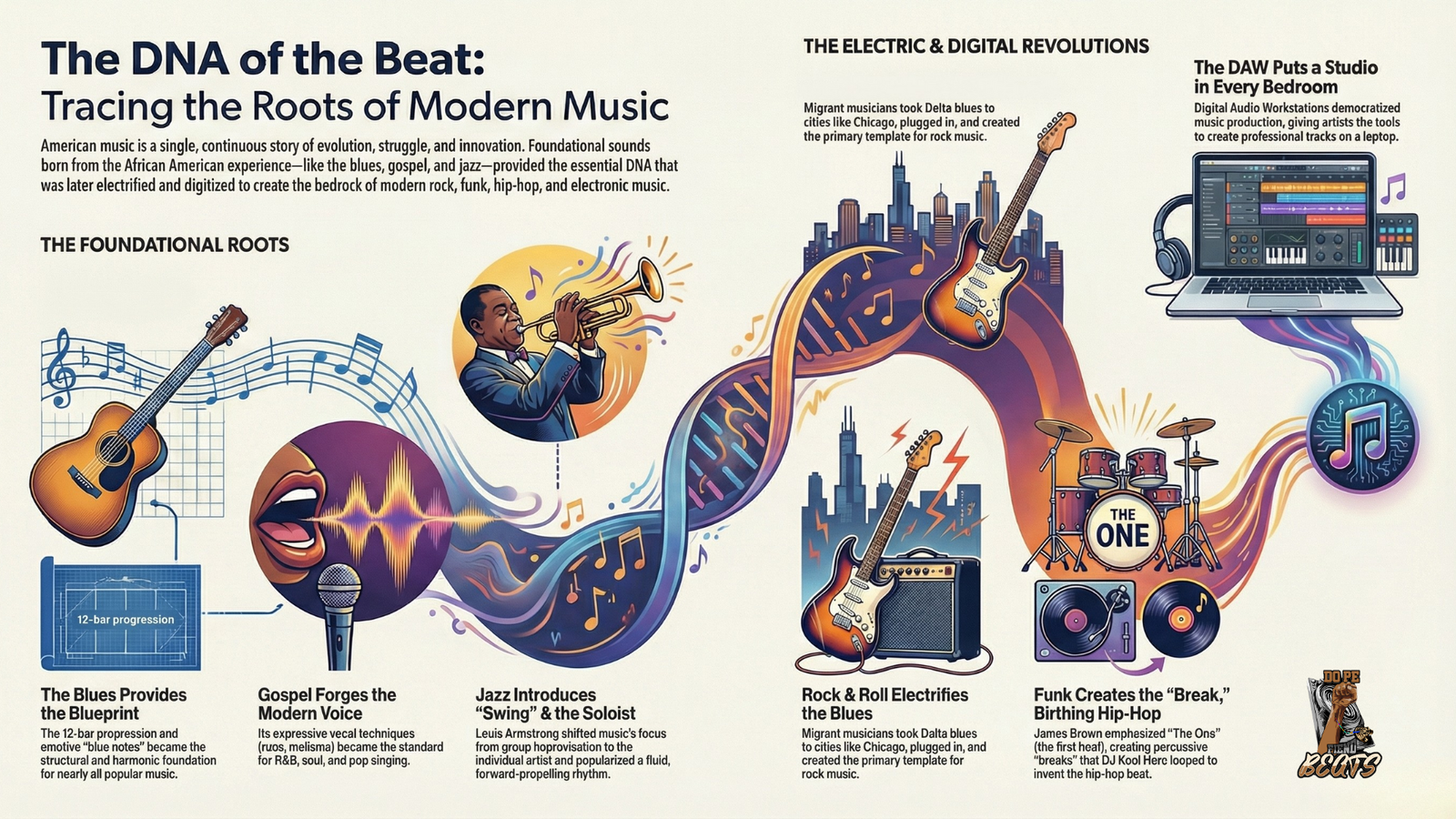
This article will explore three game-changing inventions that completely rewired the way music sounds and is made: the electric guitar, the sampler, and the Digital Audio Workstation (DAW). We’ll discover how these tools didn’t just change the music; they created entire genres and empowered new generations of artists to tell their stories.
–
1. The First Shock: The Electric Guitar Electrifies the Blues and Creates Rock & Roll
To understand the impact of the electric guitar, you first have to imagine the world without it. In the early 20th century, the dominant sound of Black folk music was the Delta blues. Born in the juke joints of Mississippi, it was a raw, personal, and acoustic sound. Artists like Robert Johnson would sit on a stool with just their guitar and their voice, telling stories of hardship and heartache in intimate venues.
The catalyst for change was one of the largest social shifts in American history: the Great Migration.
Between the 1910s and 1970s, millions of Indigenous Americans moved from the rural South to noisy industrial cities of the North. Blues musicians brought their music with them to cities like Chicago, but they quickly realized that a lone acoustic guitar couldn’t compete with the sound of a crowded, rowdy city nightclub.
The solution was simple but revolutionary: musicians plugged in. The electric guitar became the centerpiece, pushed to be louder, tougher, and more aggressive. The harmonica was amplified to create a searing, horn-like wail. Most importantly, the solo performer was replaced by a full band. A rhythm section with drums and electric bass laid down a heavy, driving beat, and the 12-bar progression became the standard framework for ensemble playing. This new, dense sound was Chicago blues.
The impact of this technological shift was transformative, creating a clear dividing line in the history of the blues.
| Acoustic Delta Blues | Electric Chicago Blues |
| Instrumentation: A single acoustic guitar and vocals. | Instrumentation: A full band: electric guitar, amplified harmonica, drums, electric bass, and piano. |
| Sound: Raw, personal, and intimate; designed for small juke joints. | Sound: Loud, dense, and aggressive; a heavy, driving beat designed to fill a noisy city club. |
| Key Artists: Robert Johnson, Son House, and Charley Patton. | Key Artists: Muddy Waters, Howlin’ Wolf, and Little Walter (at Chess Records). |
This was the sound captured on vinyl by labels like Chess Records, featuring giants like Muddy Waters and his great rival Howlin’ Wolf, a man with a voice that sounded like it was dredged from gravel. Without the amplification that allowed these artists to be heard in noisy Chicago clubs, the raw, electric energy that directly inspired bands like The Rolling Stones (who named themselves after a Muddy Waters song) might never have been captured on record. This new sound became the primary template for rock and roll.
The revolution of amplifying a sound was just the beginning. The next leap forward would come from artists learning to capture and manipulate recorded sound itself.
2. The Art of the Steal: How the Sampler Built Hip-Hop
In the 1970s, hip-hop was born not in a studio, but at live block parties in the Bronx. Pioneers like DJ Kool Herc discovered that dancers went wildest during the instrumental “breaks” of funk and soul records. Using two turntables and two copies of the same record, Herc developed a technique called the “merry-go-round.” He didn’t just play records; he deconstructed them, creating a continuous loop of pure, raw rhythm. It was a brilliant live performance technique that laid the foundation for the hip-hop beat.
The next revolution came when technology allowed producers to take Herc’s concept into the studio. The invention of the sampler; most iconically the Akai MPC, changed everything. A sampler is a machine that can digitally “capture” any sound you feed it, from a drum hit on a vinyl record to a line from a movie. Once captured, that sound can be replayed by tapping a pad, almost like playing a key on a piano. For hip-hop producers, this was a creative superpower.
The sampler had three profound consequences that fueled the creative explosion of hip-hop’s “Golden Age.”
1. The Birth of “Crate Digging” The sampler turned producers into musical archaeologists. They spent countless hours scouring record stores for obscure vinyl, searching for the “perfect beat”, a unique drum break, bassline, or horn stab that no one else had used. This “crate digging” became a core part of the culture.
2. The Beat as a Collage Producers like DJ Premier didn’t just loop samples; they became masters of chopping them into tiny, individual fragments. By assigning these fragments to different pads on their MPC, they could reassemble them into entirely new, complex, and unrecognizable melodies and rhythms, creating a beat that was a true sonic collage.
3. A New Sonic Palette Suddenly, any sound could be a musical element. The sampler allowed producers to treat a drum hit, a vocal phrase, a horn stab, or a bassline from any source as a raw ingredient. This expanded the musical palette infinitely, allowing producers to build entire worlds of sound from the fragments of the past.The sampler transformed hip-hop production from a live performance art into a sophisticated studio craft.
However, this golden age of sampling came to an abrupt end. A series of landmark copyright lawsuits in the early 1990s made clearing samples prohibitively expensive. This legal and economic reality forced producers to find new methods, forever changing the sound of hip-hop but also demonstrating that technology always operates within the forces of the real world.
The power of a single piece of hardware was immense, but the next revolution would put the power of an entire studio’s worth of hardware inside a laptop.
3. The Studio in Your Bedroom: The DAW Changes Everything
For most of the 20th century, making a professional-quality album was an exclusive and expensive process. Artists needed access to professional recording studios filled with massive mixing consoles, tape machines, and outboard gear. This meant that, in most cases, you needed a contract with a major record label. The financial barriers were enormous, and these labels acted as powerful gatekeepers, deciding who got to make a record and who didn’t.
The invention of the Digital Audio Workstation (DAW) completely shattered this old model. A DAW is essentially a professional recording studio on a laptop. Software programs like Ableton Live, FL Studio, and Logic Pro condensed the power of a million-dollar studio into a single piece of software, putting it into the hands of anyone with a computer.
This shift revolutionized the music industry in three primary ways:
• The Democratization of Production: DAWs obliterated the financial barriers to entry. Suddenly, an aspiring artist could compose, record, mix, and master an entire album from their bedroom. This unleashed a tidal wave of creativity from artists who had previously been shut out of the system.
• The Rise of the Independent Artist: With the means of production in their own hands, artists no longer needed a record label. They could now create, produce, and use digital distribution services to release their music globally, all while retaining complete creative control and a larger share of their earnings.
• The Explosion of Genre-Blending: The freedom of the DAW made it incredibly easy for artists to mix and match sounds and styles. A producer could layer a trap beat under a country vocal, or sample a classical string section into an electronic track. This led to an explosion of new hybrid genres, perfectly exemplified by the “Country Trap” of Lil Nas X’s “Old Town Road,” a song that smashed records and proved the power of this new, genre-agnostic landscape.
The DAW didn’t just change how music is made; it fundamentally changed who gets to make it. In a few short years, it toppled a half-century-old industry structure controlled by powerful gatekeepers, creating the diverse, globally connected, and artist-driven music world we live in today.This journey going from amplifying a guitar to be heard in a bar, to sampling a drum break on a piece of hardware, to programming an entire orchestra on a laptop, shows how technology continuously redefines the sound of our culture.
The Beat Goes On, Thanks to You
From the electric guitar giving birth to rock and roll, to the sampler building the sonic architecture of hip-hop, to the DAW empowering a generation of bedroom producers, technology has consistently given artists new superpowers of expression. Each leap forward unlocked new sounds, new genres, and new ways to tell stories.
But it’s crucial to remember that technology is only a tool. The true engine of musical change has always been the creativity of artists, often from marginalized communities, who took these tools and created art so powerful it conquered the world. The bluesmen of the Delta, the pioneering DJs of the Bronx, and the Indigenous and queer communities that created house music weren’t just making sounds, they were building cultures and giving voice to the voiceless.
Today, the tools are more powerful and accessible than ever before. The history we’ve explored leads directly to you, sitting with your laptop or phone. The next musical revolution doesn’t have to come from a major studio in Los Angeles or New York. With the technology available today, it could be started by anyone, anywhere, including you.
Academic & Educational Resources
- [Music – Its Language, History, and Culture (LibreTexts)](https://human.libretexts.org/Bookshelves/Music/Ethnomusicology/Music_-_Its_Language_History_and_Culture_(Cohen)
-
The Soul Of A Nation: An Epic Journey Through American Music History and the Beats That Changed Everything (https://dope-fiend-beats.store/the-soul-of-a-nation)


