

By Steafon Perry | DOPE FIEND BEATS
Published at dope-fiend-beats.store
There is a moment in music history that does not belong to any single song, album, or chart position. It belongs to a feeling. A collective exhale. A shift in the atmosphere so seismic that everything that came after it had to reckon with what came before. That moment arrived in the mid-1970s when a silver spaceship descended from the rafters of arenas across America, its hatch swung open, and a man in a floor-length ermine coat, feathered hat, and nine-inch platform boots stepped out into a wall of smoke, sparks, and 20,000 screaming people.
That man was George Clinton. That ship was the Mothership. And what Parliament-Funkadelic (P-Funk) did to music was not just move the needle. They bent it, broke it, and rebuilt it in the shape of something the world had never seen.
The Barbershop, the Backroom, and the Birth of Something New
The story of Parliament-Funkadelic does not begin on a stage. It begins in the back of a New Jersey barbershop in the late 1950s, where a young George Clinton straightened hair and dreamed of harmonies. He assembled a doo-wop group called the Parliaments, a collection of voices shaped by gospel, Motown, and the street-corner soul of the American Northeast. Nobody in that barbershop could have predicted what those voices would eventually become.
By 1967, the Parliaments had relocated to riot-torn Detroit, a city crackling with tension, rebellion, and raw creative energy. Sharing bills with the MC5 and the Stooges, they were absorbing the chaos around them and converting it into sound. Clinton was listening to everything: Jimi Hendrix’s acid-drenched virtuosity, James Brown’s primal funk, Cream’s power-riffing, Sly Stone’s multi-racial uproar. He was not trying to pick a lane. He was trying to build a highway that had never existed.
“I took all the different things and threw the shit together,” Clinton said. That sentence is the entire philosophy of Parliament-Funkadelic in eleven words.
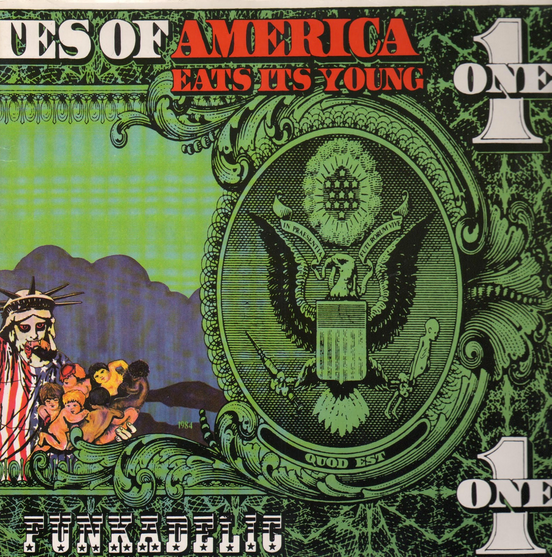
After a contract dispute forced a name change, Parliament and Funkadelic emerged as two distinct but deeply intertwined entities, both fueled by the same core musicians, the same restless creative vision, and the same refusal to be categorized. Funkadelic leaned into psychedelic rock, lysergic guitar solos, and hallucinogenic social commentary. Parliament was the more commercially accessible arm, built on horn lines, call-and-response grooves, and a conceptual ambition that rivaled anything happening in rock at the time.
Together, they were P-Funk. And P-Funk was not a genre. It was a world.
Maggot Brain, Free Your Mind, and the Sound of Liberation
The 1971 album Maggot Brain announced something that the music industry was not prepared for. Opening with a ten-minute guitar solo from Eddie Hazel, played over Clinton’s instruction to “play like your mama just died,” the record was a raw, unfiltered transmission from the intersection of Black grief, Black joy, and Black imagination. It was hard rock. It was funk. It was gospel. It was none of those things and all of them at once.
Clinton’s hallucinogenic lyrics painted a dystopian picture of the Black ghetto experience while the music demolished racial barriers in real time. White rock audiences who had never set foot in a Black neighborhood were losing their minds at P-Funk shows. Black communities were finding in Clinton’s music a set of role models and self-contained ideologies that spoke directly to their lives. The music was doing what the best music always does: it was telling the truth in a language that transcended the truth-teller’s own experience.
Free Your Mind… And Your Ass Will Follow was not just an album title. It was a directive. A challenge. A promise. Clinton understood, perhaps better than anyone of his era, that music is not entertainment. Music is transformation. Music is the thing that happens when human beings decide to stop accepting the world as it is and start imagining the world as it could be.
The Mothership Lands: Innovation as Spectacle, Spectacle as Innovation
By 1975, Clinton had assembled one of the most extraordinary collections of musical talent ever gathered under a single banner. Bassist William “Bootsy” Collins, who had left James Brown’s band after propelling milestones like Sex Machine, brought a groove so deep and elastic it seemed to bend the laws of physics. Keyboard genius Bernie Worrell added harmonic sophistication that gave P-Funk its lush, orchestral undertow. Guitarist Eddie Hazel carried the Hendrix torch with a ferocity that made audiences question what a guitar was actually capable of.
“I took that groove I got from James to Parliament-Funkadelic,” Bootsy recalled. “You could take that line and add fuzz, aeroplanes and stretch it. George already had the craziness going. All he needed was a serious groove. That was my contribution.”
Mothership Connection, released in December 1975, was the culmination of everything Clinton had been building toward. It was P-Funk’s breakthrough, the commercial package that Clinton had dreamed of without compromising his original mission. The album revolutionized funk, blew open Black music, and pointed toward an intergalactic future while embracing the heritage of Motown pop, gospel, and soul. It went gold. It predicted hip-hop. It predicted everything.
But Clinton was not finished. He had a show to build.
No Black band had ever been granted the kind of budget that Casablanca Records provided for the 1976-1977 P-Funk Earth Tour. Half a million dollars. A $275,000 spaceship. An 80-strong touring party. Four semi-trucks, three buses, a Winnebago. Broadway designer Jules Fischer. Kiss haberdasher Larry LeGaspi. A skull smoking a six-foot joint. An inflatable Rolls-Royce stripped by stage thieves every night.
And then the Mothership itself, descending from the arena ceiling in a barrage of smoke, sparks, and deafening noise, its hatch opening to reveal Clinton as Dr. Funkenstein, swaggering down the steps as the band launched into the next groove.
“All of that, we knew it was history when we was doing it,” Clinton said. “I knew that it was gonna be historic.”
He was right. The Earth Tour played to nearly a million people. It was one of the biggest box-office draws of the decade. And it established Parliament-Funkadelic not just as a band, but as a cultural institution, a living proof that Black artists could command the largest stages in America on their own terms, with their own vision, without apology.
The Funk as Philosophy: Afrofuturism Before It Had a Name
What Clinton was doing with P-Funk was not simply making music. He was constructing an alternative cosmology. A Black Utopia that existed not in the past, not in the present, but in the stars.
“I figured another place you wouldn’t think Black people would be was outer space,” Clinton explained. “I was a big fan of Star Trek, so we did a thing with a pimp sitting in a spaceship shaped like a Cadillac and these James Brown-type grooves, but with street talk and ghetto slang.”
This was Afrofuturism before the term existed in popular discourse. It was the radical act of placing Black bodies, Black voices, and Black imagination at the center of the future. At a time when Black communities were still fighting for basic civil rights, Clinton was putting Muhammad Ali in the White House on Chocolate City and landing spaceships in Times Square. He was not waiting for permission to occupy the future. He was building it himself.
The guiding principles of The Funk embraced universality. Clinton’s invitation was open to everyone: if you could free your mind, you could ride the Mothership. Race, class, background, none of it mattered once the groove took hold. This was the deeper political genius of P-Funk. It was not separatist. It was expansive. It was a vision of human possibility so generous and so joyful that it was almost impossible to resist.
The Ripple That Became a Wave: P-Funk’s Everlasting Impact
The shock waves from Parliament-Funkadelic’s work are still moving through music today. They never stopped.
Hip-hop, the dominant musical force of the past four decades, is built in significant part on the foundation that P-Funk laid. When Dr. Dre and Snoop Dogg were constructing the sonic architecture of West Coast rap in the early 1990s, they were reaching directly into the P-Funk catalog. Clinton, rather than suing or demanding exorbitant fees, embraced the connection. He understood that music is a living conversation across generations, not a property to be hoarded.
“Flash Light” reached No. 1 on the Billboard R&B chart in 1978. “Give Up the Funk (Tear the Roof off the Sucker)” went gold in 1976. One Nation Under a Groove gave Funkadelic their own mainstream hit in 1978. These were not just commercial achievements. They were proof that radical artistic vision and popular success were not mutually exclusive, that you could refuse to compromise and still reach millions of people.
The bands that followed in P-Funk’s wake read like a map of everything vital in American music: Fishbone, Outkast, Living Colour, the Red Hot Chili Peppers. Each of them carries some strand of the P-Funk DNA, the willingness to blend genres without apology, the commitment to spectacle as substance, the belief that music should demand your full attention rather than fill your background.
Clinton’s Atomic Dog, from his 1982 solo debut Computer Games, became one of the most sampled songs in history. His influence on hip-hop production is so pervasive that it is almost invisible, woven into the fabric of the music so completely that it no longer announces itself. That is the mark of a true innovator: when the innovation becomes the foundation.
What George Clinton Teaches Us About Making Music That Matters
The lesson of Parliament-Funkadelic is not about genre. It is not about spectacle. It is not even about the Mothership, as magnificent as that ship was.
The lesson is about what happens when an artist refuses to accept the world’s definition of what their music is supposed to be. When they take the traditional and flip it on its head. When they look at the boundaries of their genre and decide that those boundaries are not walls but starting points.
Clinton did not set out to create a new genre. He set out to tell the truth about his experience in the most expansive, most joyful, most uncompromising way he could imagine. The genre-bending was not a strategy. It was a consequence of honesty. When you are truly honest about the complexity of human experience, the music that results cannot be contained in a single category.
This is what it means to move the needle. Not to chase trends. Not to optimize for streams. Not to produce what the algorithm expects. But to build something so specific, so rooted in genuine vision, that it becomes universal.
DOPE FIEND BEATS: The Tradition Continues
There is a direct line from the back of that New Jersey barbershop to a studio in St. Louis, Missouri, where Steafon Perry is building something with the same stubborn refusal to settle for the expected.
DOPE FIEND BEATS is not a beat store. It is not a content platform. It is a producer brand built on the same foundational belief that drove George Clinton to land a spaceship in an arena: that music should be intentional, human, and unapologetically itself.
The catalog at dope-fiend-beats.store reflects a creative philosophy that would be recognizable to Clinton. Smooth, sensual, lush keys. Warm bass. Subtle jazz influences. A through-line of texture that ties together a genre-bending range of sounds, from rap and hip-hop to trap, urban jazz, R&B, and beyond. The surface changes. The soul stays consistent.
Like P-Funk, DOPE FIEND BEATS operates from a mandate of evolution, not repetition. The foundational elements that move people, the knock, the groove, the melody, are honored and then stretched. Familiar enough to feel like home. Strange enough to keep you leaning in.
The Sounds of Evolution Vol. I album is not a collection of loosies. It is a complete journey, arranged so that the experience rewards deep, focused listening from the first note to the last fade. This is the album-as-statement tradition that Clinton pioneered with Mothership Connection, the idea that a body of work can carry more weight than any single track, that the arc of a full project can say things that no individual song can say alone.
In a music landscape flooded with AI-generated content and algorithm-optimized output, this commitment to intentional craftsmanship is not just an artistic choice. It is a political act. It is a declaration that music is not content. Music is culture. Music is the thing that happens when a human being decides to tell the truth about what it feels like to be alive.
“In a world flooded with ‘instant music,’ the advantage is no longer speed,” Perry writes in his 2026 essay on authentic production. “The advantage is taste, story, texture, and originality.”
George Clinton said something similar, in his own way, when he described the P-Funk philosophy: “We were just doing it.” Not calculating. Not optimizing. Just doing it, with everything they had, in the most honest and expansive way they could imagine.
That is the tradition. That is the lineage. And it is very much alive.
One Nation, Still Under a Groove
George Clinton is in his 80s now. He has been touring and recording for more than six decades. The P-Funk All-Stars are still out there, still carrying the groove, still inviting anyone who can free their mind to ride the Mothership.
The music he made with Parliament-Funkadelic in the 1970s did not just move the needle. It rewired the instrument. It changed what music was allowed to be, who was allowed to make it, and what it was allowed to say. It proved that the most radical thing an artist can do is refuse to be anything other than exactly what they are.
That refusal is the gift. That refusal is the legacy. And for every producer, every artist, every listener who believes that music should demand your attention rather than fill your silence, that refusal is the ongoing invitation.
The Mothership is still out there. The hatch is still open.
Get on board.
Steafon Perry is a St. Louis, MO-based music producer, author, and owner of DOPE FIEND BEATS. Explore the full catalog, blog, and more at dope-fiend-beats.store.


